

Kinderklinik Schömberg
Our history
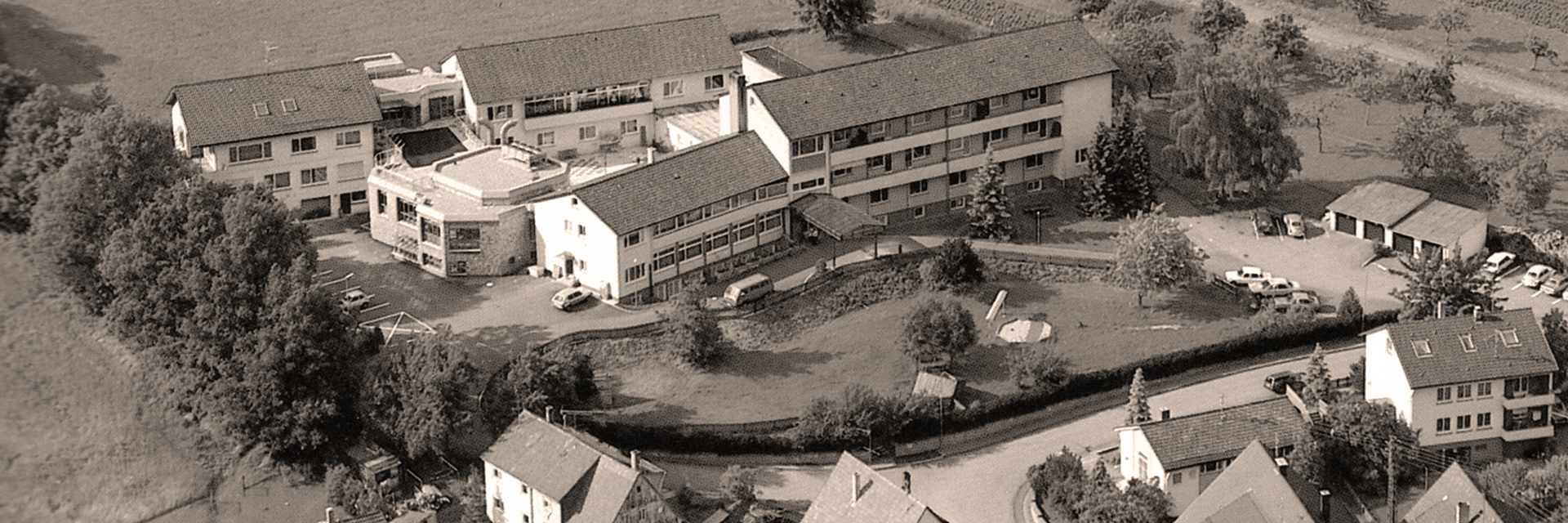
The Children's Hospital Schömberg was one of the first facilities of Reha-Südwest and is one of the first specialist paediatric neurological hospitals in Germany.
In 1971, a statement by the Ministry of the Interior of Baden-Württemberg highlighted the lack of facilities for the treatment of children and adolescents with disabilities. It was clear at the time that this problem could only be solved with the unconventional possibilities of parent self-help. A special clinic for the special needs of children with neurological diseases and disabilities was to be established. The aim was to combine a child-friendly clinic for children and young people with disabilities with intensive family and social work.
2025 – Major Changes Arise from a Shared Vision
For many years, two clinics in Maulbronn and Schömberg have focused on providing the best possible care for children and adolescents with neurological and social-pediatric conditions. Through their specialization, experience, and dedication, both facilities have carved out a unique role in patient care and have continued to grow.
Over time, it became clear that new ways of collaborating were needed to achieve even more for young patients and their families. This led to the idea of joining forces.
In 2025, a new milestone was set with the founding of the German Center for Pediatric Neurology and Social Pediatrics. The Maulbronn Children’s Center and the Schömberg Children’s Clinic are merging to combine their knowledge, experience, and capacities.
Together, they will create not only the largest independent children’s hospital in Baden-Württemberg, but also one of the most significant institutions for pediatric neurology in Germany.
The goal is clear: even better, more comprehensive, and more closely networked care for children and adolescents—inpatient, outpatient, and beyond regional borders. Two strong partners are joining forces to build a shared future dedicated to children’s health.
2022 - Anniversary year
What began half a century ago as an initiative by a parents’ self-help group has continued to evolve. The Schömberg Children’s Clinic helps to provide children and young people with neurological conditions or permanent disabilities with an appropriate care framework. This applies equally to acute care and to rehabilitation.
For 50 years, we have been committed to equality and inclusion, as well as to providing the best possible opportunities for development for children and young people with disabilities. If one compares the treatment options available today with those of 50 years ago, this is certainly a success story and a reason to celebrate. Equally, 50 years of the Schömberg Children’s Hospital represent a commitment to ensuring that medical and technical progress continues to benefit a group of very special people who are in particular need of support. In our view, a society must always be judged by how well it succeeds in caring for its most vulnerable members.
Since 2019 - with new leadership into the new decade
Since 2019, a generation change has been taking place across all departments. The kitchen management, the administrative management, the nursing management as well as the management and medical management are retiring. Tobias Renk, MD, will take over the management of the clinic. By 2024, the positions of clinic social work, deputy medical director and therapy director will be filled due to age.
2017 - another station comes into being
The ward block is raised with a spectacular structural measure, the largest roof elevation in southern Germany, and extended to include ward D.
2010 to 2011 - new premises
New construction of a therapy, school and administration building; renovation of the remaining old buildings, barrier-free and family-friendly redesign of the outdoor area.
2010 - Administrative cooperation
The Schömberg children`s hospital cooperates with the Klinikum Stuttgart.
2006 - Inpatient follow-up treatment after neuro-orthopaedic surgery
Since postoperative treatments have been carried out in individual cases for some time, the clinic is increasingly cooperating with large paediatric neuro-orthopaedic centres. It now regularly carries out corresponding follow-up treatments. The adjustment of postoperative changes in the need for aids is also carried out in-house.
2005 - new management and new therapeutic approaches
PD Dr. med. Gerhard Niemann takes over the management of the paediatric clinic.
From 2005 onwards, long-term ventilated patients are regularly cared for, and the medical and nursing team is consistently trained in the care of children who are ventilated at home. Increasingly, patients are admitted for control and readjustment of home respiration. In the meantime, the care of these patients has become an integral part of the treatment spectrum of the paediatric clinic.
2001 - the clinic comes of age
The Children's Hospital Schömberg becomes an independent subsidiary of Reha-Südwest für Behinderte gGmbH. Norbert Pietsch takes over the management and clinic management, the medical management remains in the hands of Dr. Wilfried Diener.
2000 - everything new
The new building is ready for occupancy. The clinic is reorganised with a quality initiative. The Schömberg model enjoys broad acceptance in professional circles and has served as the basis for several further developments.
1999 - "Matter of the Heart
The campaign "Herzenssache" promotes the new construction of a bed and nursing area with a donation of two million DM (German mark, equalling about one million Euro).
1996 - Swallowing diagnostics at the paediatric clinic
A cooperation began with the ENT-specialist Dr. Carl-Albert Bader from Calw, in order to be able to assess abnormalities in the swallowing act or the supply of treacheal cannulas endoscopically in house. Prof. Dr. Raimund Böckler continues this cooperation until today, increasingly supported by Dr. Tobias Renk, who has also acquired the corresponding expertise.
1994 - Clinical social work is established
With the creation of a clinical social work position, the previous parental support is professionalised. Families can receive on-site counselling on all socio-legal issues and are supported in applying for social benefits.
1992 - Visits to the KSC stadium
Initiated by an occupational therapist, the regular excursions of patients and clinic staff to the "Wildparkstadion" for the home games of Karlsruhe SC`s football team are still a highlight for many patients of the children's clinic.
1980 to 1982 - new therapeutic options
A new intermediate wing with a swimming pool and new therapy rooms is being built.
1977 - Bobath Courses School
The first training course for treatment on a developmental neurological basis according to the Bobath Concept (https://www.bobath-konzept-deutschland.de/) takes place.
1976 - expanded treatment and therapy spectrum
In the beginning, the treatment focused on children with early acquired movement disorders, for example spasticity. Since 1976, the specialists have been treating more and more children and adolescents who suffered brain damage after normal early childhood development, for example after accidents. Therapeutic horseback riding complements the range of therapies.
1975 - a very special school
The Oberschulamt Karlsruhe approves the hospital school as a state-recognised school. A school kindergarten is attached. Today, the hospital school is a private special education and counselling centre (SBBZ) for children and adolescents undergoing long-term hospital treatment.
1974 - Further training for doctors starts
Under the leadership of Dr. med. Dieter Hauf, the paediatric clinic becomes a training centre for paediatrics.
1971 to 1973 - How it all began
In 1971, the association "Rehabilitationszentrum für mehrfachbehinderte Kinder- und Jugendliche e.V. Karlsruhe" leased the private sanatorium of Dr. Schlitz KG with a one-year purchase option under its then chairman, Prof. Oskar Vivell, MD. In 1972, the building was converted to make it wheelchair accessible and the first patients could be treated. With the purchase in 1973, the "Physically Disabled Children's Clinic" was established in Schömberg, a supra-regional specialist clinic for the long-term treatment of children and adolescents with movement disorders and multiple disabilities.

Kinderklinik
Schömberg gGmbH
Römerweg 7
75328 Schömberg
Telefon: 07084 928 0
Telefax: 07084 928 260
E-Mail: info@kiklisch.de


